
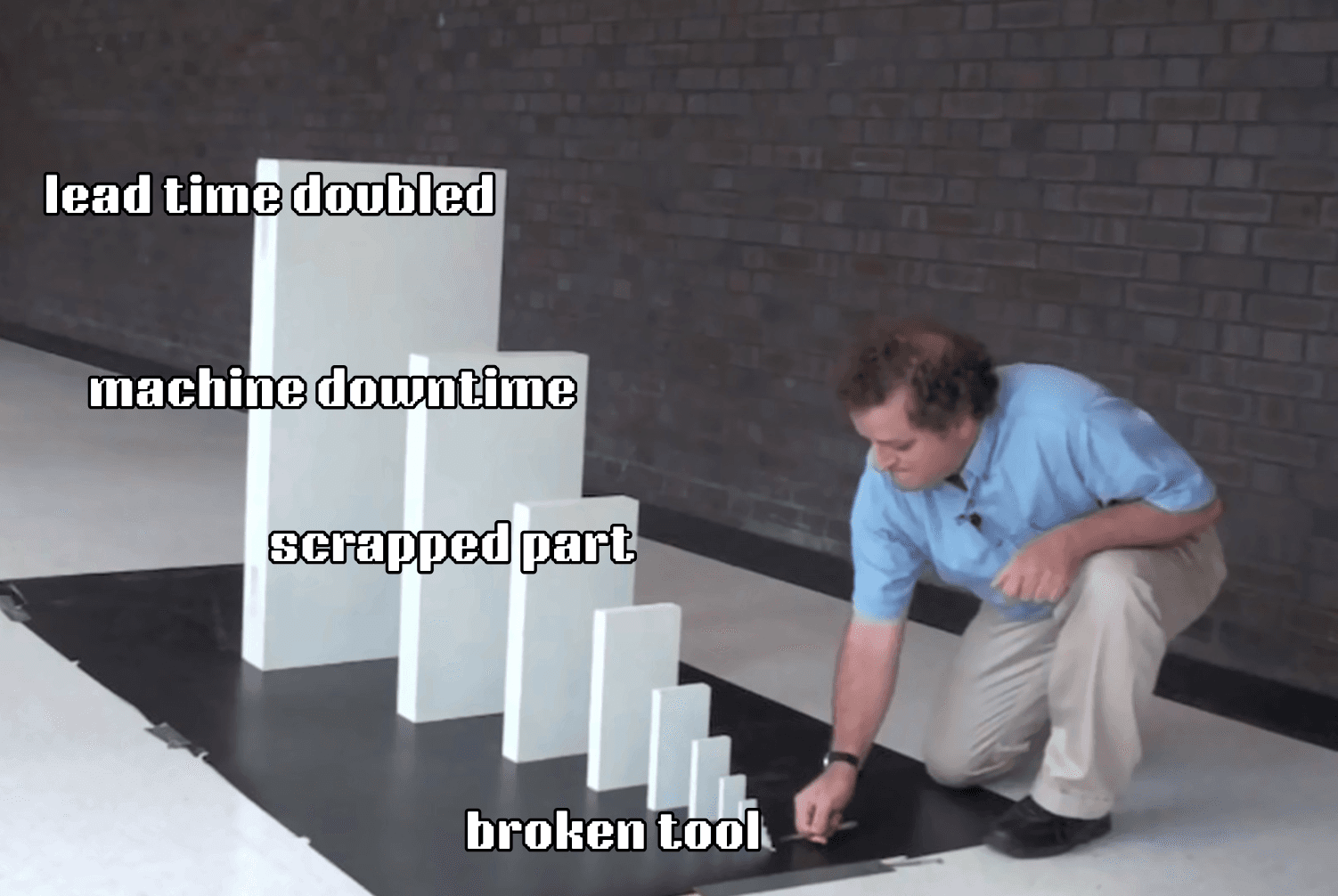
The Part Is Usually the First Casualty
When it comes to CNC machining, the moment a tool snaps, whatever part was being machined is likely ruined. Surface finish is gone and the dimensions are off but even worse, in some cases, the tool gouges the part or the fixture.
You can't just resume from where you stopped. The machine has to retract, the operator has to assess the damage, decide whether a restart is even worth attempting, and if so, figure out where in the program to pick back up. That process takes time, and it doesn't always work.
If the part is scrapped, you don't just lose the raw material but every hour of machining that went into it up to that point: the facing, roughing, drilling, whatever had already been done. A recent study from the Norwegian University of Science and Technology found that tool failures can increase unit machining costs by as much as 100%, effectively doubling the cost of a part and eliminating any profit margin.
Some Failures Hurt More Than Others
Machine shops running complex, multi-operation parts in expensive materials have it even worse. The longer the cycle time and the harder the material, the more a single tool break can cost.
Consider parts for the aerospace industry: As the Society of Manufacturing Engineers has noted, aerospace parts are often machined from tough, difficult-to-cut materials like titanium, Inconel, and other high-temperature alloys. Cycle times can run for hours. It's not unusual for a single part to represent a day or more of machine time before it's finished.
And in industries like aerospace, you frequently can't just machine another one the same day. Materials are on allocation. Lead times for forgings and castings are long. Your customer has a schedule that feeds into an aircraft assembly line. When you scrap a part that took eight hours to machine from a $3,000 billet, you're not just losing the part. You're potentially pushing your delivery out by weeks.
The machines themselves are part of the equation too. Specialized 5-axis mills and turning centers built for this kind of work are expensive and usually, the few units that machine shops have are running at capacity. More often than not, a tool failure means taking a critical machine offline at the worst possible time.
Catching Failures Before the Damage Is Done
When a tool breaks, the machine reacts. For example, the spindle motor sees a sudden spike in load and vibration in the machine structure changes.
Monitoring these shifts in real-time makes it possible to detect when a tool snaps or starts to fail, because the spindle draws power differently than normal cutting does. Vibration monitoring works on a similar idea: sensors on the machine frame pick up the mechanical signature of a break, which looks distinctly different from normal cutting vibration. Both methods can trigger an alert within seconds, warning operators about a failure or an early sign of one.
For shops running high-value parts or tight schedules, that "heads-up" can be the difference between a quick tool change and a missed delivery after days of unplanned downtime.
A Pennsylvania-based machine shop that recently deployed Sense units across their shop was able to catch a failure before anyone else noticed. The Operations Manager said:
“If the Sense system hadn't flagged the malfunction, the machine would have continued its cycle, inevitably leading to a scrapped workpiece.”
— Operations Manager, Pennsylvania Machine Shop
Tool failure is a fact of machining life. But the downstream damage, from scrap to downtime to missed deliveries, does not have to be.
Sense in your shop, risk-free.
See if you qualify for 100% money-back guarantee on your first order.