How Brighton NC Increased Machine Utilization by 10+ Percent in Just 21 Days
Innovation Built into the Company’s DNA
Brighton NC Machine is not new to manufacturing innovation.
Founded in 1965 and originally operating out of a small barn in Pinckney, Michigan, the company grew one machine at a time. The founders reinvested earnings into new equipment, steadily expanding their capabilities while building a reputation for precision machining. Over time, Brighton became one of the first privately held companies in the U.S. to adopt numerical control machining, taking an early bet on technology that paid off for decades to come.
Today, Brighton NC operates as a high-mix, low-volume shop serving industries like diesel engines, defense, and industrial manufacturing. The business remains family-owned, with Alex Barton, the third generation of the Barton family at Brighton NC, now helping lead the next phase of growth.
But despite its history of adopting new technology, one area remained largely unchanged: visibility into what was actually happening on the shop floor was still missing.
The Challenge: Wanting Machine Monitoring, But Priced Out For Years
For more than a decade, Brighton NC wanted machine monitoring. Like many shops, they understood the value immediately: knowing when machines were running, when they were down, and why could unlock meaningful gains in efficiency. They just couldn’t justify the cost. So machine monitoring stayed on the back burner.
“[Another solution] was like $10,000 per machine, plus licensing, plus maintenance. It just wasn’t even in the same ballpark. Rolling something like that out across the shop would have turned into a million-dollar investment. The conversation stopped as quickly as it started.”
– Alex Barton, Engineering Manager, Brighton NC
Meanwhile, the team continued to push performance using traditional methods, improving overall efficiency from around 75% to the mid-80s over time. But getting from “good” to “great” proved much harder. As Alex put it, “the last few percent is where it gets difficult. You’re not losing hours anymore, you’re losing minutes and seconds,” and those minutes were nearly impossible to see.
The Turning Point: A Fast, Low-Barrier Way To Get Started
“I came across Sense on Twitter, set up a meeting, got a response right away, and the rest is history.”
– Alex Barton, Engineering Manager, Brighton NC
Unlike the systems Brighton had evaluated before, Sense wasn’t a large capital project. In fact, it came in at roughly one-tenth the cost of the alternatives they had previously considered. There were no massive upfront costs, long-term contracts, or complex integrations required. The barrier to entry was low enough to try it without committing to a full rollout.
Brighton started small. A handful of machines. A few key part families. Just enough to see if the data would be useful.
The Sense team handled installation directly on-site, getting devices live quickly without disrupting production. In a shop environment where priorities shift by the hour, that speed mattered.
“Having your team come out and just get it done was huge. Setup and onboarding was just a breeze. Extremely happy with the speed and efficiency.”
– Alex Barton, Engineering Manager, Brighton NC
The Response: From Guesswork to Real-Time Visibility
“The challenge is finding those small five- or seven-minute issues. Before this, if I wanted to see that, I’d have to stand at the machine for 10 hours.
Now we can look at the data and ask, ‘What happened between these times?’ and start digging into it right away.”
– Alex Barton, Engineering Manager, Brighton NC
Almost immediately, the data began to change how the team operated. Before Sense, identifying small inefficiencies required physically standing at a machine for hours.
The team could pinpoint exactly when a machine stopped running, investigate what happened, and act on it quickly. This was especially important in a high-mix, low-volume environment where jobs may only run for a day or two. As Alex put it, “you have to catch it right now or you miss it,” making real-time data critical.
The team approached rollout with transparency, reinforcing that the goal was to improve processes, not police operators. With a seasoned workforce and strong internal trust, adoption was smooth.
“We haven’t had any pushback. Everyone understands the goal is to make as many good parts as possible.”
– Alex Barton, Engineering Manager, Brighton NC
The Result: Immediate Efficiency Gains and a New Operating Model
“It was almost instantaneous. As soon as we started having some data and going and asking what these looked like, we got feedback and were able to put corrections in place.
It worked, it worked fast, so we just said let’s keep going.”
– Alex Barton, Engineering Manager, Brighton NC
By focusing on a few critical, underperforming machines, the team identified issues that had previously gone unnoticed, including a tool that had gradually degraded in performance. It wasn’t broken, but it required frequent adjustments, introducing small pockets of downtime that added up over time. These are the kinds of issues that would have been easy to miss without continuous visibility.
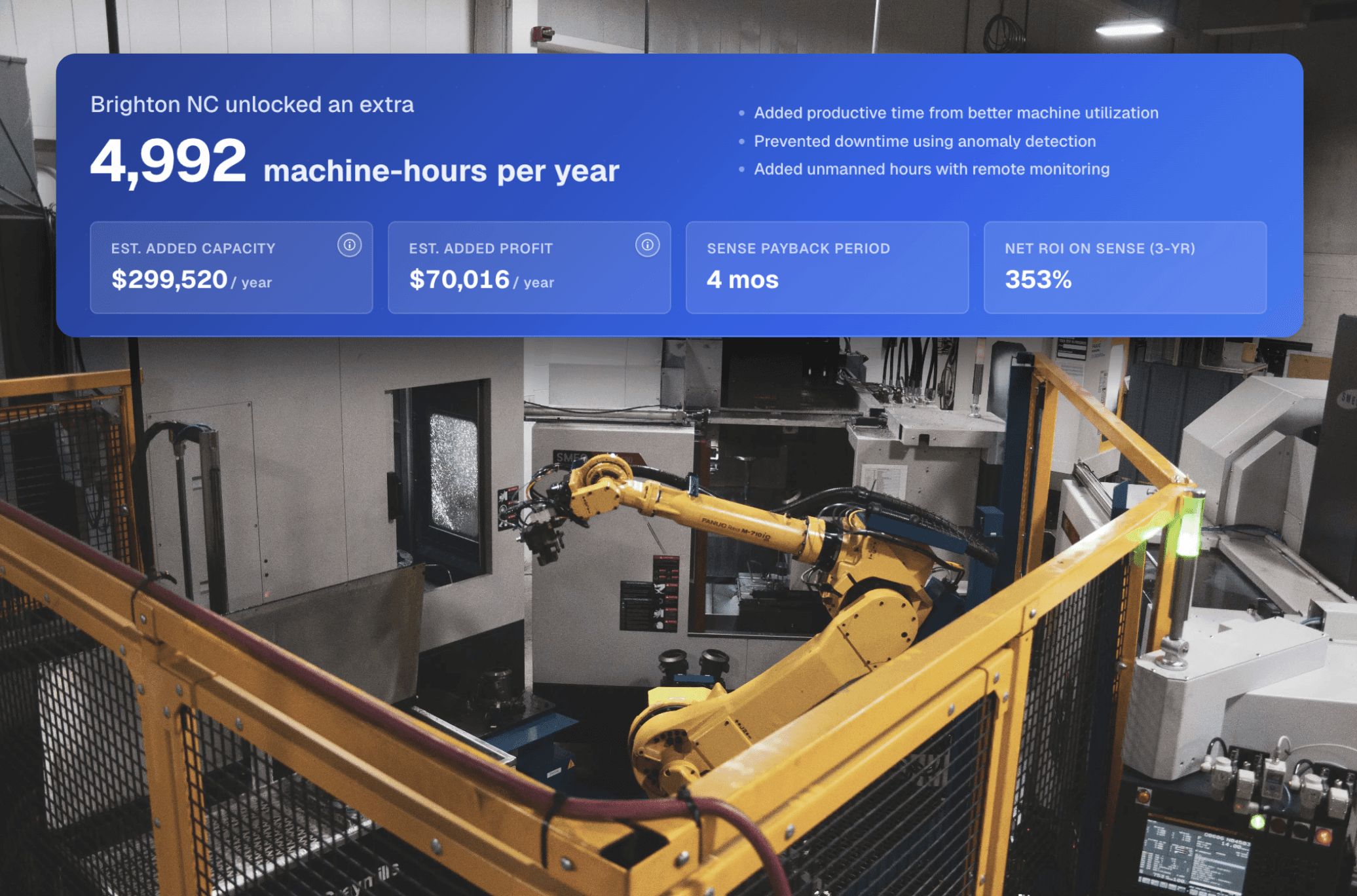
The fixes were almost immediate. One machine returned to target efficiency, while another climbed from around 75% to the mid-80s. Across those initial machines, the team saw roughly a 10% increase in utilization.
Within the first three weeks, the results spoke for themselves. Brighton NC expanded their Sense deployment 5x across the shop.
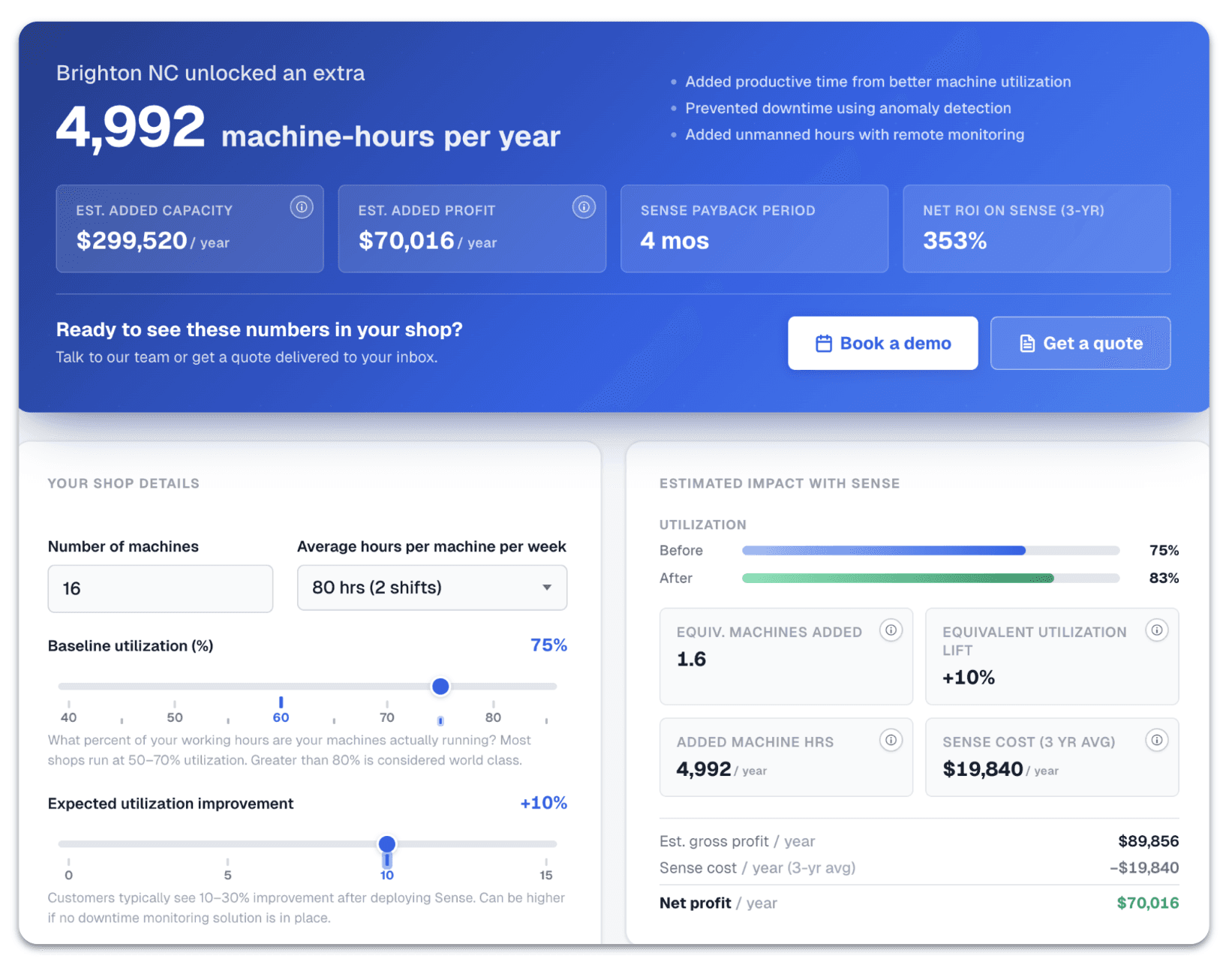
Want to calculate your own estimated results? Try our 2-minute ROI Calculator!
Looking Ahead: Rethinking The Shop Floor
“I think of it as a digital supervisor, or really multiple digital supervisors, because instead of one person walking around trying to figure out why a machine isn’t running, now we have that visibility across everything at once.”
– Alex Barton, Engineering Manager, Brighton NC
The long-term shift is operational. Rather than walking the floor to chase down problems one machine at a time, the team can see everything at once and focus their attention where it matters most.
The small stuff – like five-minute delays, unnecessary changeovers, and other inefficiencies – is no longer invisible. It's visible, it's tracked, and it gets fixed.
For a shop that spent decades evolving alongside new technology, adopting Sense was just a natural continuation of that same mindset.
Find the hidden capacity in your factory.
Sense shows where machines are underutilized, where downtime is happening, and how to increase output without buying new equipment.

Designed with purpose by Takton.
© 2026. All rights reserved.